
As we began our homeschooling journey with Mumbi and Wangari, one of the first things we decided to do was study the laws and principles that relate to children and education in Kenya.
As a family, we have spent time reading and discussing important documents, including:
- The Constitution of Kenya
- The Basic Education Act (2013)
- The Children Act (2022)
Our goal is not to become lawyers or legal experts. Our goal is to understand our responsibilities as parents and to ensure that every decision we make places the interests of our children first.
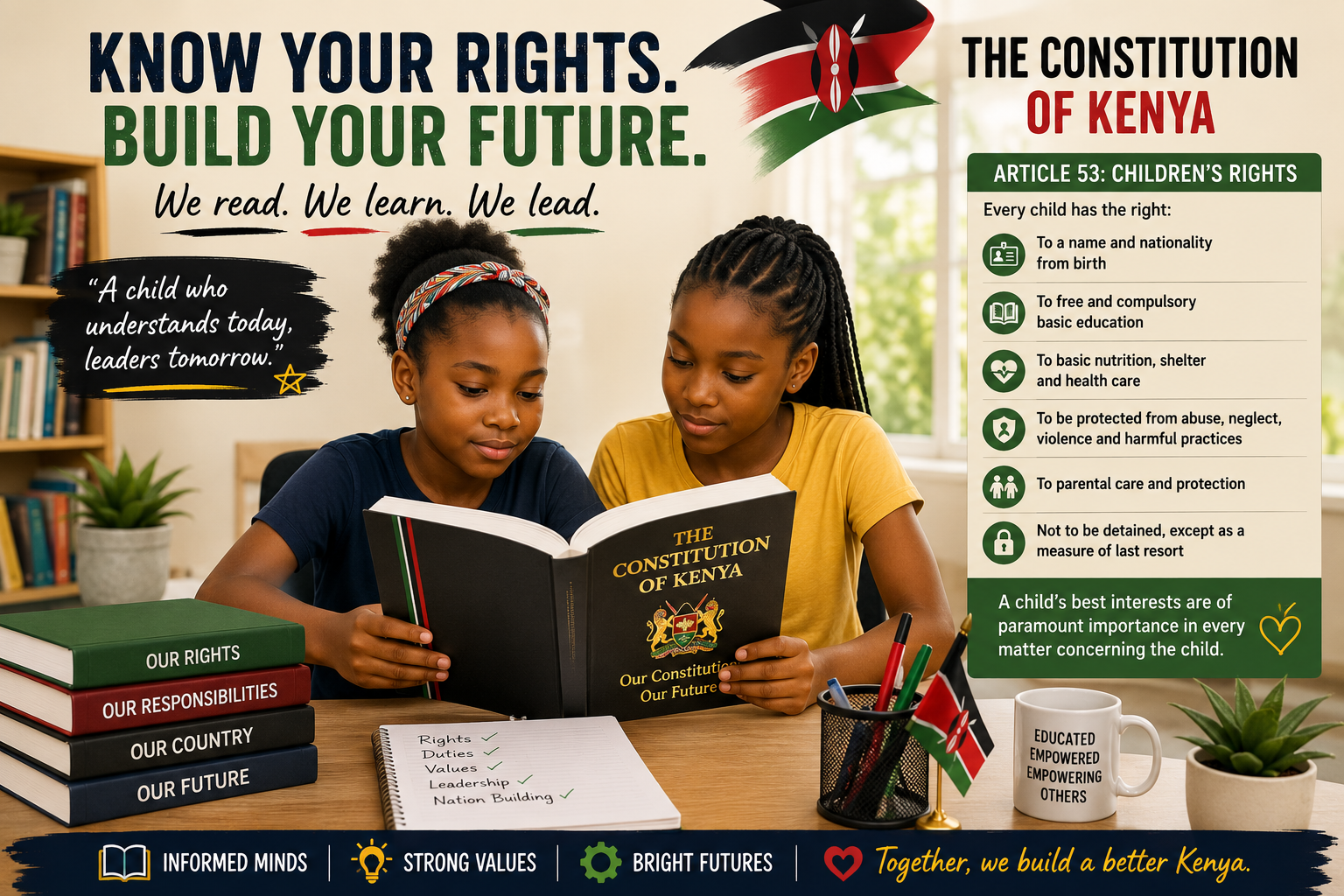
One constitutional provision that stands out is Article 53, which deals specifically with the rights of children.
The Child Comes First
Article 53(2) of the Constitution states:
“A child’s best interests are of paramount importance in every matter concerning the child.”
For us, this is one of the most important statements in the entire Constitution.
It reminds us that every decision affecting a child should begin with a simple question:
What is in the child’s best interests?
Not what is easiest.
Not what is most common.
Not what everyone else is doing.
But what genuinely serves the child’s welfare, development, safety, education and future.
As parents, we believe this principle carries both a privilege and a responsibility.
Education Is a Constitutional Right
Article 53(1)(b) states that every child has the right:
“to free and compulsory basic education.”
We fully support this principle.
Education is not optional.
Every child deserves the opportunity to learn, develop knowledge, acquire skills, and prepare for adulthood.
As parents, we view education as one of our most important responsibilities.
However, our understanding of education goes beyond attendance in a physical classroom.
We believe education involves:
- Learning
- Understanding
- Critical thinking
- Communication
- Creativity
- Character development
- Practical life skills
- Preparation for adult life
These are the goals we seek to achieve through our homeschooling journey.
Parental Care and Responsibility
Article 53(1)(e) states that every child has the right:
“to parental care and protection, which includes equal responsibility of the mother and father to provide for the child.”
This provision reminds us that education cannot be delegated entirely to schools, teachers, governments or institutions.
Parents remain responsible for:
- Guidance
- Character formation
- Protection
- Mentorship
- Emotional support
- Educational decisions
Whether children attend public schools, private schools, international schools or are educated through other approaches, parents remain the primary caregivers and decision-makers.
For us, homeschooling is one way of exercising that responsibility.
Education Is More Than Academics
Article 53 also recognizes other important rights of children.
Children have the right to:
- Nutrition
- Shelter
- Health care
- Protection from abuse
- Protection from neglect
- Protection from violence
- Protection from exploitation
These rights remind us that education cannot be separated from overall well-being.
A child who is academically successful but emotionally neglected is not receiving complete care.
A child who excels in examinations but lacks life skills may still struggle later in life.
A child who is physically present in school but loses confidence, curiosity, or motivation may require additional support.
As parents, we try to look at the whole child rather than focusing exclusively on grades.
Why We Study These Laws as a Family
One of the benefits of homeschooling is that learning is not limited to traditional subjects.
We want Mumbi and Wangari to understand:
- Their rights
- Their responsibilities
- The Constitution of Kenya
- Citizenship
- Leadership
- Good governance
- The rule of law
The Constitution is not just a document for lawyers, politicians or judges.
It belongs to every Kenyan.
By studying it together, we hope to help our children understand both their freedoms and their responsibilities as future citizens.
Our Commitment as Parents
Reading the Constitution, the Basic Education Act and the Children Act has reinforced our belief that parenting is one of the most important responsibilities anyone can have.
Homeschooling is not about avoiding responsibility.
In many ways, it increases responsibility.
It requires us to be more involved in:
- Teaching
- Planning
- Mentoring
- Monitoring progress
- Character development
- Health and safety
- Daily learning activities
It requires time, commitment, patience, and accountability.
For our family, homeschooling is not simply an educational choice.
It is a commitment to being actively involved in the growth and development of our children.
Conclusion
As we continue our homeschooling journey, we remain guided by one principle that stands above all others:
The best interests of the child.
This principle is found in the Constitution of Kenya.
It is found in the Children Act.
It is reflected in the responsibilities placed upon parents.
And it serves as the foundation for every educational decision we make.
Our goal is simple:
To provide Mumbi and Wangari with an environment where they can learn, grow, develop good character, acquire practical skills and prepare for a meaningful future.
As parents, we may not have all the answers, but we remain committed to learning, improving, and doing our best to place the interests of our children at the center of every decision we make.